
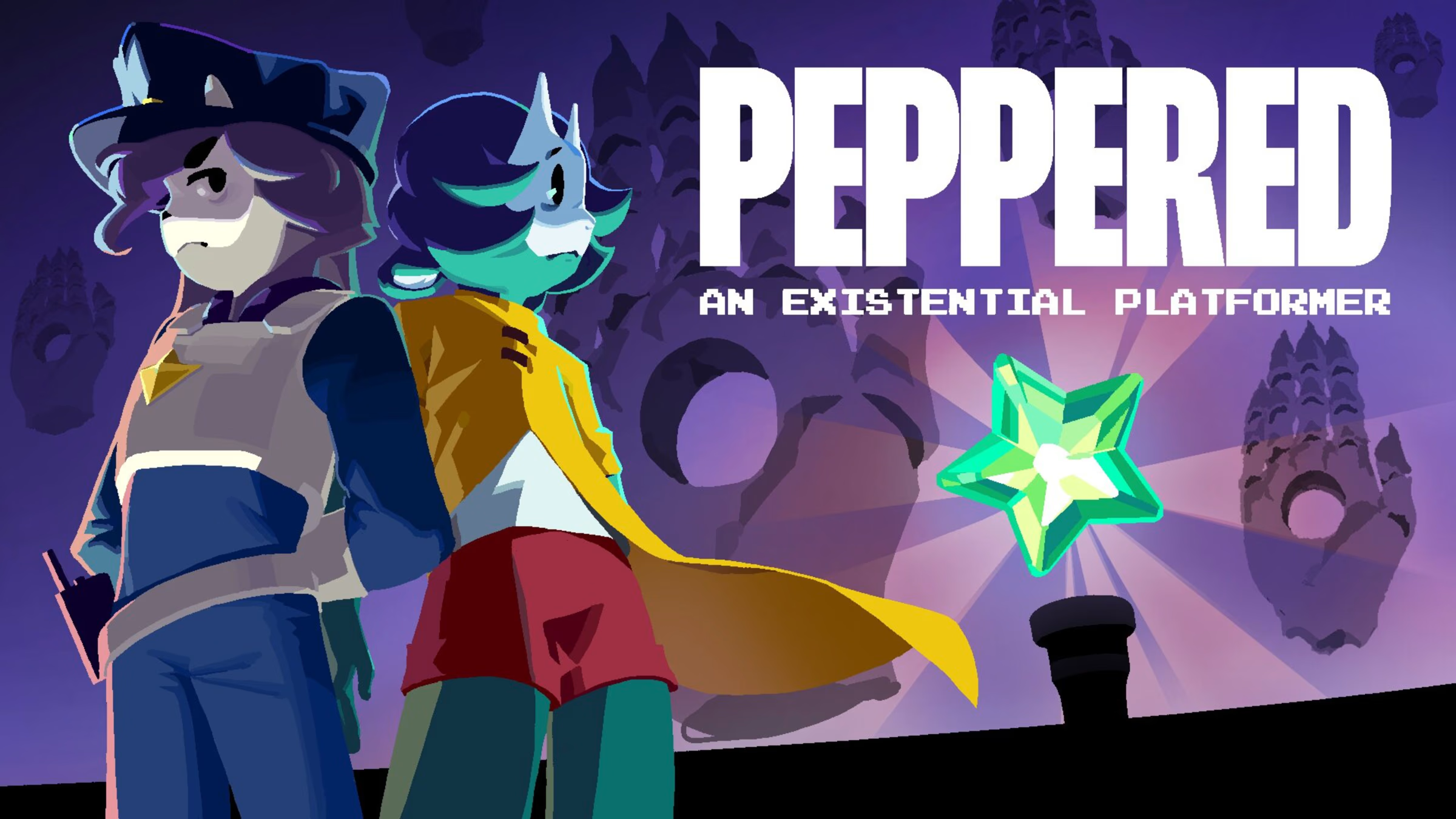
Developer: Mostly Games
Publisher: Mostly Games, Black Soup
Genre: Story Rich, Action-Adventure
Price: $14.99
Release Date: Apr 7, 2025
Where to buy: Steam, Switch
In video game design, player choice is frequently presented as an empowering mechanism. Titles often feature quick-saves, forgiving checkpoints, or branching morality meters that permit players to optimize outcomes and reverse errors. Developed by Mostly Games, PEPPERED: An Existential Platformer intentionally subverts these mechanics to explore themes of absurdity, helplessness, and moral responsibility. Set against the backdrop of an impending apocalypse, the game follows an ordinary office worker who attempts to avert catastrophe. Through its strict one-shot progression, genre hybridity, and critique of late-stage capitalism, PEPPERED transforms standard platforming mechanics into a commentary on the weight of human action.

The central narrative framework of PEPPERED relies on the subversion of traditional hero tropes. The protagonist is not a chosen savior, but an average civilian surrounded by society’s collective apathy as the God of Death approaches. When the protagonist steps forward to take initiative, the world does not celebrate their effort; instead, institutions respond with hostility, labeling the intern a public threat. This narrative dynamic reflects philosopher Albert Camus’s concept of the absurd—the conflict between the human desire for meaning and the indifferent, often hostile universe. The protagonist’s attempt to act meaningfully in an indifferent society underscores the game’s core existential inquiry.

Ludologically, PEPPERED reinforces its thematic focus through its permanent choice mechanics. Unlike conventional platformers that allow players to retry failed boss encounters or platforming challenges until perfection is achieved, PEPPERED features single-try encounters. Losing a battle or failing a stealth section does not result in a “Game Over” screen; rather, the game continues forward, forcing the narrative to adapt to and permanently incorporate the player’s failure. This design choice mirror Jean-Paul Sartre’s assertion that humans are defined by their actions and must bear the inescapable weight of their consequences. Failure in PEPPERED carries lasting narrative weight, removing the safety net typical of interactive media.

Furthermore, the game utilizes structural unpredictability to mirror the chaotic nature of daily life. While functioning primarily as a 2D precision platformer, PEPPERED continually interrupts its base gameplay with erratic minigames, corporate tasks, stealth sequences, and absurd dialogue choices. One segment may demand precise movement, while the next requires managing mundane office work or navigating street-level bureaucracy. This dissonance between heroic aspiration and mundane, systemic absurdity highlights how contemporary socio-economic structures—such as soul-crushing labor and bureaucratic friction—drain individual agency.

In Closing, PEPPERED: An Existential Platformer uses interactive mechanics to present an argument about responsibility and systemic inertia. By removing traditional failure-reset loops and imposing real consequences on every action, Mostly Games shifts the platformer from simple entertainment to a critique of agency. The game demonstrates that attempting to do good in a flawed world is fraught with failure, hostility, and regret, yet the decision to act remains the defining characteristic of existence. Through its blend of dark humor and permanent mechanics, PEPPERED illustrates that while we may not control the outcome of our efforts, we remain fully responsible for making them.