
Developer: Dogubomb
Publisher: Raw Fury
Genre: First Person, Puzzle
Price: $29.99
Release Date: March 3, 2026
Where to buy: Switch
Developed by Dogubomb and published by Raw Fury, Blue Prince established itself as one of the most innovative puzzle-adventure titles in recent memory through its genre-defying blend of first-person exploration, architectural drafting, and rogue-lite mechanics. Tasking players with navigating the ever-shifting interior of Mt. Holly Manor in search of the elusive Room 46, the experience relies heavily on strategic spatial reasoning and atmosphere. While the initial release captivated PC and console audiences with its intricate puzzle design and eerie narrative depth, its arrival on the Nintendo Switch 2 marks a pivotal evolution for the title. This hardware transition presents both a showcase for portable hardware capabilities and a test of how a dense, interface-heavy mystery adapts to a hybrid console format.
Gameplay and Mechanics Adaptation
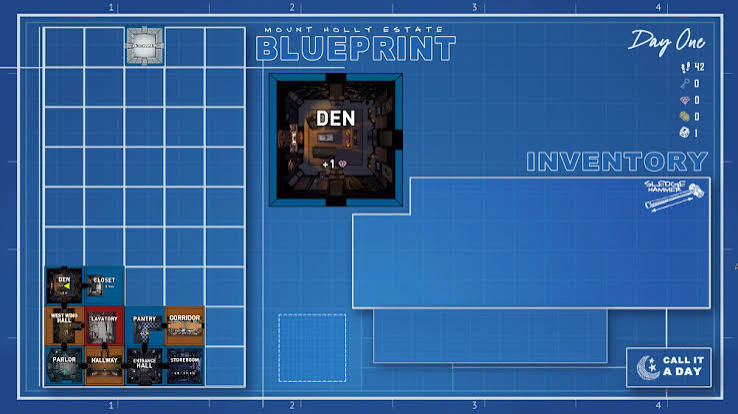
At its core, Blue Prince operates on a drafting loop where every closed door prompts the player to select from a randomized draw of room blueprints, balancing step counts, resources, and structural synergy. On the Nintendo Switch 2, these core mechanics gain a subtle boost in accessibility through hardware-specific features. Navigating floor plans and placing room tiles translates naturally to capacitive touch controls in handheld mode, allowing for fluid estate planning without relying solely on analog navigation. Furthermore, HD rumble integration adds tactile feedback to daily resets, floor locks, and key discoveries within Mt. Holly, grounding the abstract layout drafting into a surprisingly tangible physical process.
Visuals, Performance, and Technical Execution
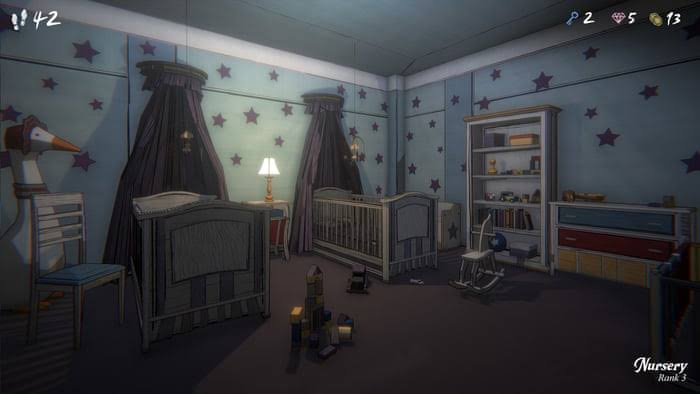
Blue Prince relies on a distinct stylized aesthetic characterized by clean architectural lines, muted color palettes, and delicate lighting effects that evoke atmosphere without requiring photorealistic rendering. The Nintendo Switch 2 handles this presentation smoothly, targeting a steady frame rate that prevents motion judder when panning across complex, multi-room structures. Text legibility—a frequent pitfall for puzzle-heavy indie games ported to handheld screens—is cleanly preserved, ensuring fine print on in-game documents, floor blueprints, and clue notes remains crisp. Enhanced memory bandwidth on the updated hardware also mitigates load times between daily estate resets, maintaining the momentum necessary for an engrossing puzzle loop.
The hybrid nature of the Switch 2 fundamentally alters how players engage with Blue Prince‘s long-form mystery. In docked mode, playing on a home screen highlights the grander architectural scope of Mt. Holly Manor, turning clue hunting into an immersive, living-room detective session. Conversely, handheld play leans directly into the bite-sized nature of individual daily runs, turning complex drafting sessions into ideal portable challenges. The ability to suspend a run mid-draft allows players to step away from particularly head-scratching room layouts, give the puzzle time to incubate, and return with a fresh perspective—an operational advantage inherent to the system’s form factor.
In Conclusion, the Nintendo Switch 2 edition of Blue Prince stands out as a definitive home for Dogubomb’s ambitious puzzle design. By combining tactile input options with hardware capabilities capable of maintaining clean performance and swift loading, the port successfully retains the eerie charm and strategic depth of the original release. It proves that intricate, thinking-person’s adventure games do not need to compromise when making the leap to flexible hardware. For both seasoned estate navigators and newcomers pursuing the secrets of Room 46, this edition offers a seamless and versatile way to experience one of the genre’s most clever accomplishments.